You want songs, unplugged
Campfire chords, singer-songwriter parts, folk patterns, or hymn-simple progressions.
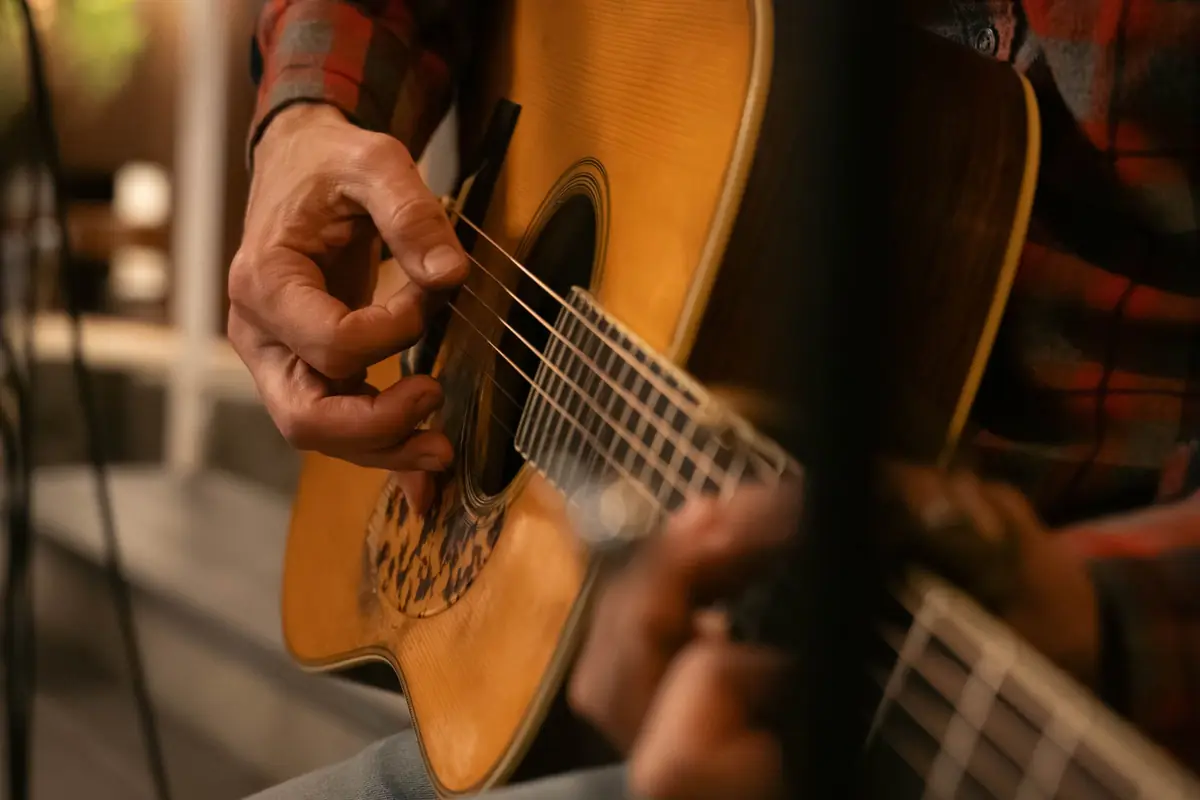
Acoustic lessons are about sound you make with your hands alone: the attack of a pick or a fingernail, the clarity of a chord change, and the dynamics a knob cannot fix.
On an acoustic guitar, a heavy hand is the volume knob. That is useful, and it is also why sloppy muting and late chord changes are obvious. Lessons work on the right hand as much as the left: strum shape, where the pick meets the strings, and how to keep a pattern going while the fretting fingers move.
Fingerstyle is not a separate school on this site. It is a technique you add when the music needs bass notes and melody at the same time. If you are still forming open chords, start there. The beginner guitar lessons page is the setup. If you are deciding against an amp, compare this with electric guitar lessons.
Fit
Campfire chords, singer-songwriter parts, folk patterns, or hymn-simple progressions.
No amp, no cable. The instrument has to be in tune and comfortable enough to practice on a couch.
You know the shapes and the arm speeds up, or every chord change stops the groove.
Travis-style patterns, simple arpeggios, or a bass-and-chord approach, introduced when the open chords are stable.

In the lesson
Down, down-up, and a pattern with a rest. The strings should ring together. A strum that catches only the top two strings is a contact problem, not a musical style.
Common pairs such as G and C, or D and A, practiced under a count. The fretting hand moves as a group. One late finger buzzes the whole change.
Pick near the bridge for a brighter sound, closer to the neck for a warmer one. Fingernails or fingertip flesh change the attack. Acoustic tone is mostly this, plus fresh strings.
A steady thumb on the bass strings and fingers on the top strings, slowly. Independence comes from a pattern you can keep while you talk, not from speed.
Verse, chorus, and where the progression repeats. Playing a song means knowing the map, not only the hardest bar.
Shape of a session
Tune first. An acoustic that is a quarter-step off will make a correct chord sound wrong, and you will “fix” your fingers instead of the pegs.
Then one pattern and one set of changes, played slowly enough to hear which string died. The lesson records the pattern in a way you can read at home: arrows, counts, or a simple tab, whichever you will actually use.
If you sing, the guitar has to stay steady while the voice moves. That coordination is its own practice and is added only after the strum can survive without the voice.
Preparation
If the strings sit very high, chords will hurt and sound choked. Mention that. A setup is a repair question, not something this website sells.
Lighter strings are easier to press and sound a bit thinner. Heavier strings are fuller and harder on new fingers. Do not change gauge the night before a lesson without noting it.
Bring the pick you like. A medium pick is a reasonable default. A clip-on tuner is enough.
Early wins are a chord that rings and a strum you can repeat for eight bars. Later work is dynamics: quiet verse, fuller chorus, and changes that do not thump. Nobody can honestly promise you a performance date.
Electric players who want the same songs unplugged can move between this page and electric guitar lessons. The fretting hand transfers. The right hand often has to be rebuilt because an amp was hiding a light touch.
Questions
The strings are often heavier and there is no amp to fill in a thin strum. The chord knowledge is the same. People who practice the one they own improve on that one.
You can start a simple pattern early, alongside chords. A complicated arrangement before the chord changes are reliable usually falls apart. The order depends on the song.
Not unless the music is classical fingerstyle and you want that feel. This site does not publish a separate classical program. Steel-string acoustic covers most song-based goals.
First check the fretting finger and a string you did not mean to mute. If a string buzzes in many chords, the instrument may need a setup. The lesson can help you tell those apart.

Name a song and whether you strum, pick, or are not sure yet.
Request a lesson